The Australian Bushland Program has the potential to protect Australia’s most important landscapes, but only if its design supports rapid, large‑scale conservation.
Background
The Australian Government is designing a conservation investment component of the Australian Bushland Program (ABP), to support strategic land purchases that help expand Australia’s protected area system. The program aims to contribute to national commitments to protect 30% of Australia’s land by 2030, a target agreed by all Australian governments under the United Nations Global Biodiversity Framework.
Australia must dramatically scale up protection of high value landscapes to meet the 2030 target.
Success is dependent on good design
Land acquisition is one of the fastest, most effective ways to secure biodiversity at scale, but success depends on strong federal leadership, flexible funding models, and partnerships with states, land trusts, and philanthropy.
A report co published by ALCA and partners, Protecting Australia’s Nature: Pathways to protecting 30 per cent of land by 2030, identified a dedicated federal land purchase fund as a critical pathway to achieving 30 by 30.
However, the draft ABP design proposes that the Commonwealth contribute only 33% of purchase costs and separates contributors into discrete “streams,” limiting collaboration. This approach will not stimulate the level of investment needed to drive meaningful conservation outcomes.
ALCA’s recommendations
Increase the Commonwealth contribution to at least 50%
The current proposal suggests the Commonwealth would fund only 33% of each acquisition. This will be insufficient to drive meaningful demand from land trusts, philanthropy, or state governments, all of whom are expected to co invest and absorb ongoing management costs. The earlier National Reserve System Program - Australia’s most successful protected area expansion effort - used a two thirds Commonwealth contribution, enabling large scale, coordinated purchases across jurisdictions. A minimum 50% federal investment is needed to make the program viable, fair and effective.
Design a single, flexible funding model
The ABP proposal splits contributors (Commonwealth, states, land trusts, philanthropy) into distinct “streams.” Real-world land acquisition depends on multiple parties pooling resources. A unified, flexible model would allow different partners to co invest in opportunities as they arise, and ensure funding can move where it is most needed, rather than being restricted by administrative siloes.
Ensure the program can move quickly
Land acquisition is highly time sensitive and often depends on rapidly shifting market conditions. Sellers may move quickly, competition can be high, and opportunities can disappear abruptly. The Commonwealth must commit clear funding upfront and avoid designs that “test demand” before allocating funds, because the program itself creates the demand. Uncertainty will deter participation.
Be clear about the total federal funding pool
The Commonwealth should publicly state how much funding is available for land purchases under the ABP. Without this transparency, organisations will struggle to assess whether it is worth investing staff time, philanthropic support and negotiations into acquisition proposals.
Allow flexibility beyond the 2030 deadline
Permanent protection mechanisms such as national park declarations or conservation covenants often take time. If acquisitions occur late in the program, some protection steps may extend beyond June 2030. ALCA recommends allowing final payments and legal processes to be completed after 2030, ensuring the program can still deliver high quality long term protection. A rigid deadline risks losing conservation opportunities through administrative timing alone.
Prioritise protected areas over OECMs unless protected-area status is not possible
Under Australia’s National OECM Framework, Other Effective Area-based Conservation Measures (OECMs) should only be used where a formal protected-area designation is not available. ALCA recommends the ABP follow this principle to ensure the land purchased contributes clearly to Australia’s protected area network and strengthens the National Reserve System.
Avoid publishing overly detailed maps of priority areas
Releasing property level maps could unintentionally drive up land prices by signalling government interest to sellers. ALCA recommends publishing maps no finer than IBRA subregion scale to prevent market distortions while still giving the sector guidance.
Do not exclude land types or uses upfront - focus on biodiversity value
ALCA urges the government not to “rule out” particular land categories in advance. Instead, the program should assess suitability based on biodiversity value, ecological connectivity, and how well a property contributes to a Comprehensive, Adequate and Representative protected area system. This avoids missing high value conservation opportunities simply due to land type.
Embed self determination and FPIC for First Nations partners
The program should be designed so Aboriginal and Torres Strait Islander organisations can contribute to 30 by 30 in ways that align with their aspirations, cultural values and rights, consistent with the UN Declaration on the Rights of Indigenous Peoples and the CBD Target 3 framework. This includes ensuring Free, Prior and Informed Consent for involvement in projects.
Clarify the eligibility of Australian Carbon Credit Unit (ACCU) and Nature Repair Market projects
Explicitly state whether carbon or nature repair projects undertaken on ABP acquired land would conflict with “additionality” requirements in those markets. Clear guidance is needed to avoid uncertainty. Where legally possible, such projects should be allowed to provide extra incentives for long term stewardship and restoration.
With the right design – particularly through stronger federal investment, flexible funding, and collaborative delivery – the Australian Bushland Program can play a major role in expanding protected areas and meeting Australia’s 2030 nature commitments.
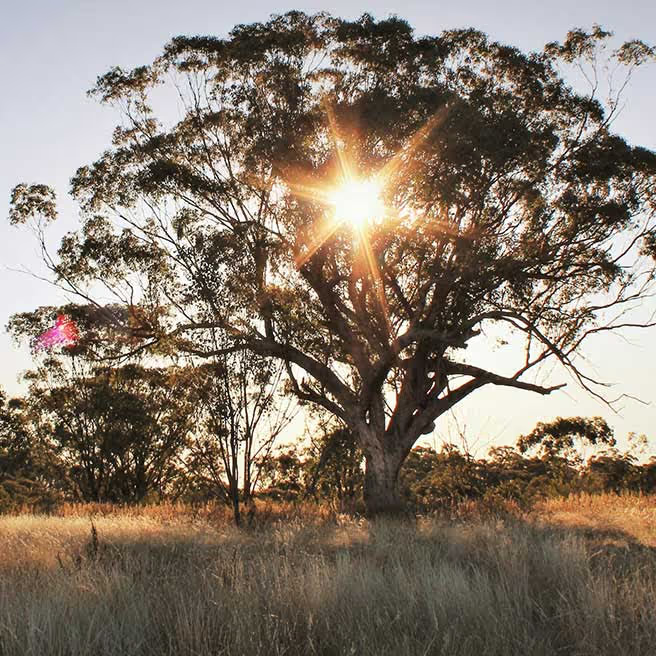
Image: Elaine Alex / Unsplash